 *Subject to validation

Entry Requirements
Minimum of 48 UCAS points

Study Mode
Full time

Duration
Full time:
2 years

Timetable
Speak to your Tutor
Key Features & Benefits
- Validated by UK Top 15 Lancaster University
- Learn from expert lecturers with specialist industry knowledge and experience
- Fit your studies around existing commitments
- Benefit from smaller class sizes
- Study additional aspects across Psychology on this Criminology pathway
- *Subject to validation
Ever thought why different people commit different crimes? Why do victims react differently? What is crime and who are the types of people that commit it? Or even wondered what actually constitutes a crime? Do you have a strong interest in how these questions relate to trauma, mental health and evolving psychological understanding? Well then studying our Criminology with Psychology Foundation Degree could be for you!
-
Overview
-
As part of this course you will study the areas of law, forensics, and sociology, as well as in-depth study relevant to your specialist pathway with Psychology. This means that alongside core Criminology modules you will also study at least two specialist Psychology modules for your chosen specialism at each level of study.
Psychology-informed skills have become increasingly necessary because many career roles now require staff to understand behaviour, vulnerability, trauma, mental health and communication, rather than simply relying only on procedural or enforcement knowledge. At its core, criminal justice is about human behaviour: why people offend, how risk is managed, how harm is reduced, and how change happens. By combining criminological theory with the science of human behaviour, you will develop an evidence-based understanding of why offending happens and how it can be prevented.
Across policing, probation, and other criminal justice services, we are seeing that criminology graduates entering the job market will increasingly require psychological skills. These include communication, risk assessment, trauma-informed practice, emotional awareness and behaviour-change knowledge. Skills and understanding in these areas are increasingly essential in order to work effectively across police, probation, prisons and victim-focused services. Our Criminology with Psychology pathway provides this foundational knowledge and understanding helping increase your employability and effectiveness across these areas.
This course should also to appeal to you if you need to fit studying around other commitments, or if you are looking to take your first step into higher education after a gap of study. It is also ideal whether you have previous knowledge of psychology or are new to studying or working in the field.
This Lancaster University validated foundation degree will equip you with the skills and knowledge for employability in a range of roles across the Justice and Criminal sectors, with a focus on areas requiring in-depth knowledge and skills understanding behaviour, vulnerability, trauma, mental health, research, and communication.
-
-
What will I study?
The study of crime requires a multidisciplinary approach and therefore law, forensics, psychology and sociology are all important subjects on the course. You will study a core set of common topics along with students on our other Criminology pathways of Cyber Crime and Probation Studies.
You will then specialise with two modules in your specialist area developing specific additional knowledge of Psychology. You will be taught your specialist modules by experts in that field.
This structure enables you to develop specific specialist knowledge and skills alongside a strong grounding in core criminological theory, policy, and practice.
Employer-led curriculum
The use of employers and practitioners in delivering the curriculum ensures that what you learn is current and relevant to the roles and careers you will be seeking, whether looking to begin your career in the field or progress from your existing role in the justice system if you are, or have, already worked in the area.
The development of your skills, in addition to knowledge, is a core part of the course and our experienced and approachable lecturers have a proven track record in delivering a quality learning experience that does just that. this gives you a practical edge, and an applied understanding that helps underpin and enhance your employability.
Work placement and additional activities
You will also have the opportunity to engage in a work placement relevant to your specialism to gain experience of working in the sector.
You can get involved in additional activities such as volunteering, guest lectures with key criminal justice representatives as well as trips to prisons, courts and youth offending organisations.
Modules
You will take a total of 120 credits per level (Levels 4 and 5).
Common Criminology modules
Students on our three pathways all study four common modules at each level of study. These modules focus on:
- Core criminological theories and concepts
- The criminal justice system and its institutions
- Social, political, and ethical dimensions of crime and deviance
- Academic, research, and professional skills relevant to criminology
Level 4 module list:
- To follow
Level 5 module list:
- To follow
Specialist modules for PsychologyThese specialist modules will:
- Develop specific perspectives, contexts, and vocational applications in Psychology
- Build subject depth and applied understanding
- Support informed career development where psychological knowledge are skills are in demand
Level 4 module list:
- To follow
Level 5 module list:
- To follow
This course is new for September 2027 so is designed specifically for current and future requirements of the field. It is subject to validation, so further information will be published when confirmed.
-
Become a part of the Cold Case Unit
Real cases. Real crimes. Real experience.
Investigate on real-life cases, provide support to law enforcement agencies and more...
Find out more about the Cold Case Unit (CCU) and how to get involved.
-
Entry Requirements
You’ll need 48 UCAS points to join this programme (formerly 120 UCAS points).
All applicants must show that they have a good level of spoken or written English, and if English is not your first language you’ll need to demonstrate the ability to study in English.
Applicants who do not meet the standard entry criteria but have relevant work / life experience will be considered on an individual basis and may be invited to interview.
Care Leavers or Young Carers
We want students from all backgrounds to have the opportunity to go to University. If you have spent three months or more in local authority care OR are a young carer, you will be eligible for a contextual offer. This is a grade reduction of 1-A Level grade below our standard entry requirements. For example, a standard offer of CCC, would become CCD. MMM at Level 3 Extended Diploma would become MMP. To apply we advise that you tick the box on your UCAS application which identifies you have spent time in care and to help identify you as eligible for our contextual offer.
-
How will I be assessed?
You will not be assessed by examinations on this course. Throughout the course a full range of other assessment techniques will be used.
Each module is formally assessed through, for example:
- in-tray exercises;
- oral presentations;
- collaborative group task
- report writing
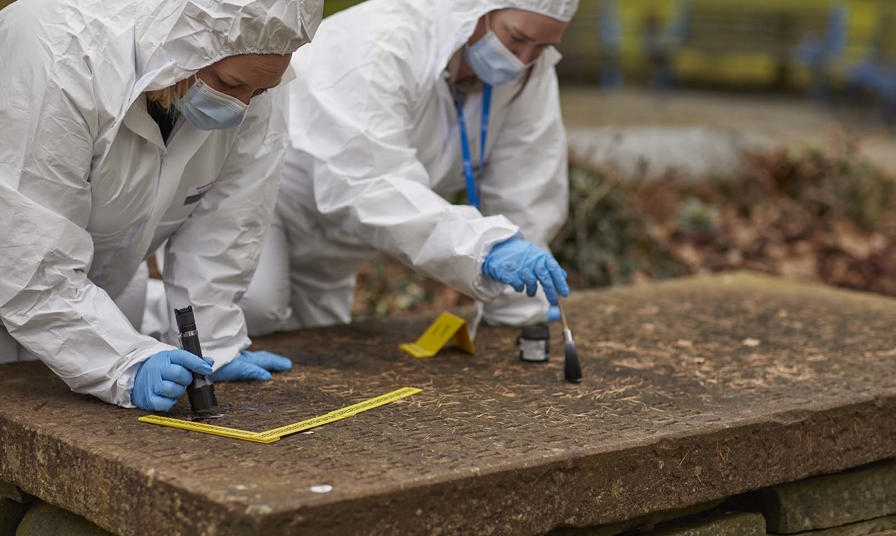
- crime scene assessment, and;
- other related coursework.
These formal assessments will count towards your module mark and feedback is usually given within 3 weeks of the deadline for submitting your work. In addition, formal feedback is provided at regular points during your studies. Feedback is intended to help you learn and you are encouraged to discuss it with your module tutor. An advantage of our smaller class sizes is the fact our tutors will know you better, and be able to advise accordingly, compared to other larger institutions.
-
Teaching and Learning
The learning environment and facilities across our courses include lecture theatres, classrooms, technology suites, laboratories and workshops, library and skills labs, art and photography studios, small group and quiet zones.
Learning methods will vary according to the programme of study but will include lectures and group tutorials. In addition, seminars, field trips, work placements, role play or scenario activities, laboratory and workshop practical, demonstrations, guest lectures, discussions and debates all contribute to the learning experience to support the acquisition of subject specific skills and knowledge and the development of transferable and employment related skills. You will also benefit from our Cold Case Unit (CCU).
In addition to your Guided Learning contact hours (see Study Hours below), you will also have timetabled meetings with your personal tutor.
You will be taught by an experienced teaching team whose expertise and knowledge are closely matched to the content of the modules on the course. The team could include senior academics, professional practitioners with industry experience, demonstrators and technical officers. You can learn more about our staff by visiting our staff profiles.
Timetables
On this course, you will generally spend up to 2 days a week in College, if you choose to study the course full-time. As all course timetables are subject to change you should not make definite plans based on this information; this information is intended as a guide only. Please remember that you will be expected to carry out work in your own time in addition to the time you spend in College.
Overall workload
Your overall workload consists of class contact hours (Guided Learning), Independent Study, and assessment activity and any field trips which may take place.
See the Study Hours section below for more information.
Academic Support
We have a dedicated Student Engagement Team who will be able to provide support in the following areas;
- Study Skills (including reading, note-taking and presentation skills)
- Written English
- Academic Writing (including referencing)
- Research Skills
Work Placement
During the course you are required to spend at least 240 hours (120 hours per year) working in a relevant role in order to improve your knowledge and practice of the subject. This may be through paid employment or via a voluntary work placement in a relevant role. Your work placement is expected to have a focus on applying the knowledge from your degree programme in an employment context.
Please note: work placements are subject to availability. You are also responsible for any costs in travelling to and from your work placements, for any accommodation costs and in some instances the cost of acquiring a satisfactory Disclosure and Barring Service (DBS) report.
-
What can I do next?
Graduates from the foundation degree can progress on to BA (Hons) Criminology with Psychology (Top Up), which will also be validated by Lancaster University.
Graduates from this specialism will be able to become:
• Offender Rehabilitation Officer
• Prison Officer / Prison Services Manager
• Safeguarding Officer
• Youth Justice Officer
• Behavioural Intelligence Analyst
• Detective
• Restorative Justice PractitionerBA (Hons) Criminology with Psychology (Top Up) is subject to validation.
-
Fees and Financial Information
-
Fees and Finance
Fees
Studying for a degree is not as expensive as you think – especially if you stay local. There are no upfront fees to pay if you take out a Tuition Fee Loan from Student Finance England.
Financial support
There is a range of financial support available to you, including generous support from the College.
Additional costs
There may be additional costs to consider that are not included in the tuition fees. These costs can vary based on your course and personal choices.
There are some general additional course costs to consider that can apply to all courses:
-
Study Hours
This is a full-time course so you will undertake both Guided Learning and Independent Study.
- Guided Learning may take the form of lectures, seminars, workshops, field trips and visits, or 1-to-1 supervision/tutorial.
- Independent Study will take place in your own time, either on or off campus, and will be used for reading, research, and the completion of coursework.
Studies per module
In each academic year, for each module, you will receive approximately*:
- Level 4 (per module) – 60 hours Guided Learning, supported by 140 hours of Independent Study
- Level 5 (per module) – 50 hours Guided Learning, supported by 150 hours of Independent Study
- Level 6 (per module) – 45 hours Guided Learning, supported by 155 hours of Independent Study
Modules may take place in a semesterised design or a linear fashion:
- Semesterised design means they will run September until December (15 weeks), or January to May (15 weeks)
- Linear fashion means they will run the full year (30 weeks).
On rare occasions modules may have a different weighting of credits, duration through the year, or both.
*Based on a 20-credit weighting. Please refer to module specifications for variations in this weighting.
Weekly study
Each week you will normally study for approximately:
- Level 4 (per week) – 12 hours of Guided Learning, up to 2 hours of tutorial (based on group size), and 28 hours of Independent Study
- Level 5 (per week) – 10 hours of Guided Learning, up to 2 hours of tutorial (based on group size), and 30 hours of Independent Study
- Level 6 (per week) – 9 hours of Guided Learning, up to 2 hours of tutorial (based on group size), and 31 hours of Independent Study
Further details
The amount of Guided Study, and how it is distributed per week, will be shown in your Timetables and Subject Outlines. You can determine the schedule of Independent Study yourself around your lessons.
The overall design of your modules and study hours is detailed within Module Specifications. These are available upon request.
-
Terms and Conditions
Every effort has been made to ensure the accuracy of our published course information. However, our programmes are subject to on-going review and development. Changing circumstances may cause alteration to, or cancellation of courses. Changes may be necessary to comply with the requirements of accrediting bodies or revisions to subject benchmark statements. We may also make changes to keep courses updated and contemporary, or as a result of student feedback. We reserve the right to make variations if we consider such action to be necessary or in the best interests of the students.
Explore your career options

95.8%
Highest in the area for students feeling supported by teaching staff in their learning.