

Entry Requirements
You'll be required to pass an interview and you'll need 5 GCSEs at Grade 5 or above including Maths, English & Science.

Study Mode
Part Time.

Duration
42 months plus 3 months EPA, Off the job hours 744

Timetable
Day Release
Key features and Benefits
- Skills Provider of the Year - BiBAS Winner 2025
- Ofsted Grade "Good" - Nov 24
-
Overview
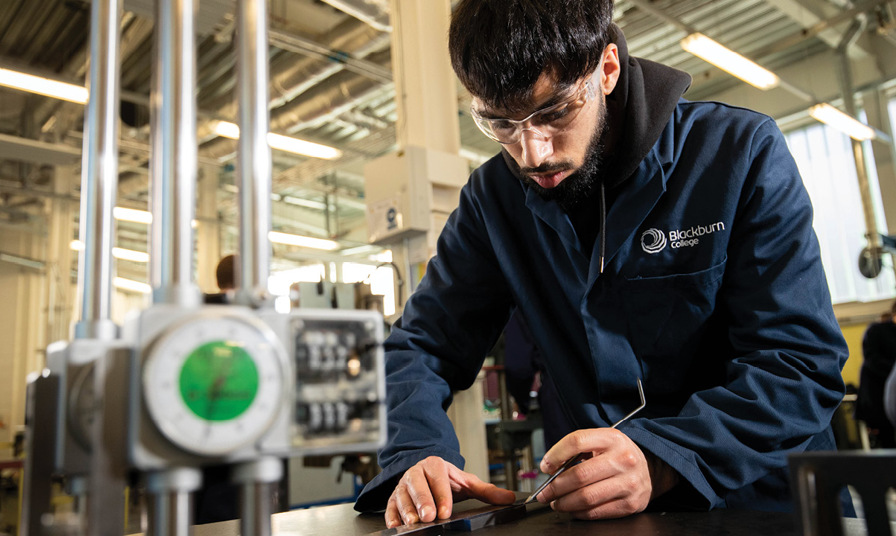
Skilled engineering machinists work in dynamic workplaces to create precision parts which are then used on a daily basis, across the world, in almost everything you use or see.
These components are produced from metal or specialist materials using traditional machining operations such as manual milling and turning or advanced methods such as CNC machines.
Machining Technicians need to be able to interpret engineering drawings and plan and implement the production of complex parts.
This will involve setting up, operating and adjusting tool settings or producing, proving and editing CNC programs to produce high quality parts to fine tolerances.
-
What will I study?
As well as learning the fundamentals of engineering theory and manufacturing processes, you will gain experience in both manual and advanced machining techniques.
You will then learn how to use the latest computer numerical control (CNC) machines tools to cut, drill and finish components.
During your apprenticeship you will develop the key knowledge, skills and behaviours needed to succeed within the Engineering Sector.
You will work towards the Machining Technician Level 3 Standard.
-
Entry Requirements
Grade 5 or above in Maths.
Grade 4 or above in English and Science and a further 2 GCSE's at 4 or above.
A Level 2 Engineering Qualification will also be considered
-
How will I be assessed?
During the apprenticeship you are assessed in a number of ways including:
- Short Answer Exams
- Assignments
- Observation
- Portfolio of Practical Work
At the end of your time on programme you will complete an End Point Assessment that will include a practical observation and a professional discussion underpinned by a reflective portfolio, these elements will be conducted an external examiner.
-
What can I do next?
This standard aligns with the following professional recognition:
- Institution of Engineering and Technology (IET) for Engineering Technician (EngTech)
- Institute of Mechanical Engineers (IMechE) for Engineering Technician (EngTech)
Or you can progress onto a Higher Advanced Engineering Apprenticeship.
Lead Engineering Maintenance Technician (Level 4)
-
Apprenticeship Funding
When you start an apprenticeship with us, there’s no need to worry about the cost—apprenticeship fees and funding are covered by your employer, not you. This means you can focus fully on gaining valuable skills and experience without any financial burden.
For more information on apprenticeship funding/costs and any government support available, please contact our Apprenticeship Team on 01254 292500 or apprenticeships@blackburn.ac.uk


99.4% Apprenticeship End Point Assessment Achievement
Results 2025