
 *Subject to validation

Entry Requirements
Completion of the FdA Criminology with Cyber Crime

Study Mode
Full time

Duration
Full time:
1 year

Timetable
Various
Key Features & Benefits
- Validated by UK Top 15 Lancaster University
- Graduates progress into a diverse and varied set of careers
- Top Up your Foundation Degree to a full bachelors in one year
- This Top Up course will have its first cohort in 2029 when students progress from the Foundation Degree
- Experience lessons taught by UK-renowned academic, Dr Phil Johnson, who is the course leader for the Criminology degree programmes and co-author of one of the UK’s leading Criminology text books
- This course is subject to validation
Building on the two years of learning and experience gained on our FdA Criminology with Cyber Crime Foundation Degree, this one-year Top Up course completes your Bachelor's degree.
-
Overview
This Criminology with Cyber Crime BA (Hons) (Top Up) course enables you to turn your foundation degree into a full BA (Hons) qualification.
The course will prepare you with the tools to critically analyse criminological ideas, and criminal justice and cyber crime concerns as an ethical, professional practitioner in the sector whilst developing your critical engagement with key debates and theories.
Advanced specialisation
The BA (Hons) Top up at Level 6 consolidates and extends your learning in your specialist pathway through a blend of modules from each pathway, one of which is aligned to their chosen pathway.
The modules are designed to engage you with advanced and emerging topics, enabling you to critically evaluate contemporary theory, research, policy, and practice from a range of different perspectives.
Whilst continuing to study a range of modules, this approach allows you to work in ways expected in contemporary workplaces in criminal justice, where practitioners increasingly require interdisciplinary skills involving behavioural insight, communication, analytical thinking and evidence-based decision-making.
This has clear benefits for both in your learning and also developing your employability, including:
- assessment and skill development
- intellectual progression, depth and criticality
- integration of theory and practice
- development of graduate competencies
- increasingly independent, self-directed scholarship
- the ability to apply knowledge in complex and uncertain contexts
- specialism-specific expertise with a focus on graduate employability
BA (Hons) Criminology with Cyber Crime (Top Up) and FdA Criminology with Cyber Crime are both subject to validation.
-
What will I study?
At Level 6 you will build on the core knowledge, professional practice and research skills modules that you have completed at Levels 4 and 5. The teaching, learning and assessment will develop and deepen your critical thinking and analysis of key concepts within criminology and your chosen specialism of Cyber Crime.
Core modules (all pathways)
- Contemporary Issues in Criminology and Criminal Justice
- Child First Youth Justice
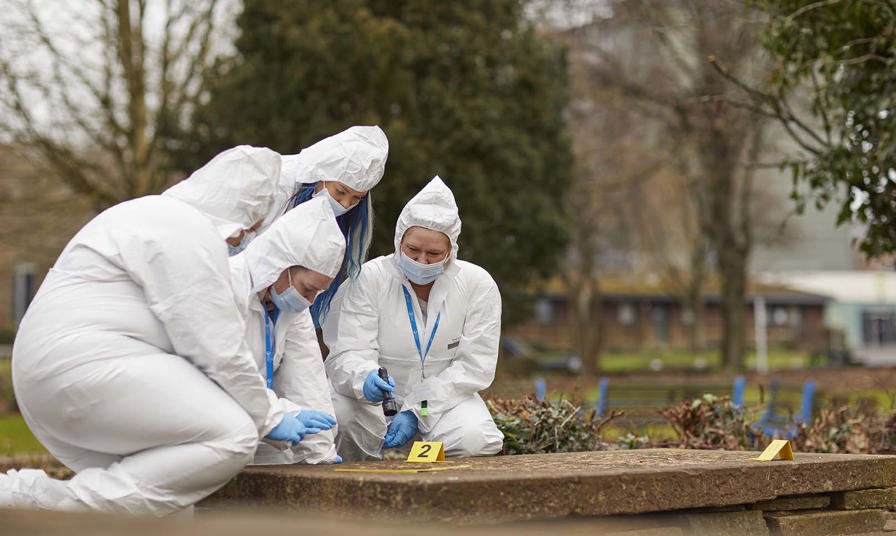
- Crime Scene Investigation and Digital Forensics
- Crimes of the Powerful: Culture, Harm and State-Corporate Crime
Specialism module
- Crime Scene Investigation and Digital Forensics
Capstone research
You will complete two capstone research projects that are explicitly aligned to your chosen specialist pathway.
- Research Project (dissertation) - independent research aligned to your specialism
- Applied Research Report - practice-focused research that is aligned to your specialism
The capstone projects enables you to:
- Design and undertake independent, supervised research
- Apply criminological theory and research methods to topic in your specialist area
- Demonstrate advanced critical thinking, ethical awareness, and academic autonomy
This gives you the opportunity to bring together all of your learning and skills development with a deep dive into your specialist area. Completing this project provides strong evidence of your subject specialism and overall knowledge and effectiveness.
-
Become a part of the Cold Case Unit
Investigate on real-life cases, provide support to law enforcement agencies and more...
Find out more about the CCU and find out how to get involved here.
-
Entry Requirements
In order to join this BA (Hons) Top Up programme, you will need to have successfully completed our Foundation Degree in Criminology with Cyber Crime.
-
How will I be assessed?
Assessment will be undertaken through a range of established methodologies at various stages throughout the student learning experience. This incorporates standard practices through initial, diagnostic, formative and summative stages. Examples of assessment activity includes:
- Essays
- Critical Reflections
- Case Study Exercises
- Research outputs
- Seminars
- Examinations
- Reports
- Group presentations
- In class assessments
- Self-assessment and peer to peer assessment
- Group assessment
-
What can I do next?
After successful completion of the BA (Hons), graduates in Criminology have gone on to specialise within:
- Youth Justice Workers
- Restorative Justice Workers
- Community Rehabilitation
- Community Safety Officers
- Counselling & Mediation Officers
- Housing
- Community Cohesion
- Homelessness
- Antisocial behavioural Officers
- Special Constables
Our graduates have also entered into careers in the more traditional aspects of criminal justice, such as:
- The Probation Service
- The Police
- The Prison Service
Your specialism in Cyber Crime will prepare you for careers as:
- Serious and Organised Crime Investigator
- Fraud and Financial Crime Investigator
- Digital Forensics Analyst
- Cyber Security Analyst
- Intelligence Officer
- Police Officer
- Criminal Investigator
You would also be able to progress to further study in postgraduate programmes in relevant or related subject area such as:
- MA/MSc/MRes
- Professional Qualification in Probation (PQiP)
- PGCE
-
Fees and Finance
Fees
Studying for a degree is not as expensive as you think – especially if you stay local. There are no upfront fees to pay if you take out a Tuition Fee Loan from Student Finance England.
Financial support
There is a range of financial support available to you, including generous support from the College.
Additional costs
There may be additional costs to consider that are not included in the tuition fees. These costs can vary based on your course and personal choices.
There are some general additional course costs to consider that can apply to all courses:
-
Study Hours
This is a full-time course so you will undertake both Guided Learning and Independent Study.
- Guided Learning may take the form of lectures, seminars, workshops, field trips and visits, or 1-to-1 supervision/tutorial.
- Independent Study will take place in your own time, either on or off campus, and will be used for reading, research, and the completion of coursework.
Studies per module
In each academic year, for each module, you will receive approximately*:
- Level 4 (per module) – 60 hours Guided Learning, supported by 140 hours of Independent Study
- Level 5 (per module) – 50 hours Guided Learning, supported by 150 hours of Independent Study
- Level 6 (per module) – 45 hours Guided Learning, supported by 155 hours of Independent Study
Modules may take place in a semesterised design or a linear fashion:
- Semesterised design means they will run September until December (15 weeks), or January to May (15 weeks)
- Linear fashion means they will run the full year (30 weeks).
On rare occasions modules may have a different weighting of credits, duration through the year, or both.
*Based on a 20-credit weighting. Please refer to module specifications for variations in this weighting.
Weekly study
Each week you will normally study for approximately:
- Level 4 (per week) – 12 hours of Guided Learning, up to 2 hours of tutorial (based on group size), and 28 hours of Independent Study
- Level 5 (per week) – 10 hours of Guided Learning, up to 2 hours of tutorial (based on group size), and 30 hours of Independent Study
- Level 6 (per week) – 9 hours of Guided Learning, up to 2 hours of tutorial (based on group size), and 31 hours of Independent Study
Further details
The amount of Guided Study, and how it is distributed per week, will be shown in your Timetables and Subject Outlines. You can determine the schedule of Independent Study yourself around your lessons.
The overall design of your modules and study hours is detailed within Module Specifications. These are available upon request.
-
Terms and Conditions
Every effort has been made to ensure the accuracy of our published course information. However, our programmes are subject to on-going review and development. Changing circumstances may cause alteration to, or cancellation of courses. Changes may be necessary to comply with the requirements of accrediting bodies or revisions to subject benchmark statements. We may also make changes to keep courses updated and contemporary, or as a result of student feedback. We reserve the right to make variations if we consider such action to be necessary or in the best interests of the students.
Explore your career options

95.8%
Highest in the area for students feeling supported by teaching staff in their learning.